
Maybe you have tightened up your home, added new windows, or are planning a high-efficiency build, and now every contractor seems to be asking the same question: HRV or ERV? At the same time, you might be noticing stale bedrooms in the morning, foggy windows on cold days, or cooking smells that hang around far too long. It can be hard to tell whether the problem is your furnace, your air conditioning, or something deeper in how fresh air moves through your home.
In older, leakier houses, this choice rarely came up because outdoor air slipped in through cracks and gaps. Today’s better-sealed homes are great for comfort and energy bills, but they mean you have to be more deliberate about ventilation.
Modern building science, tighter building envelopes, and newer home construction techniques all place greater emphasis on balanced ventilation and indoor air quality.
In this guide, you will learn the differences between an HRV vs ERV ventilation system, what HRVs and ERVs actually do to your air, how climate and humidity drive the decision, how tighter homes change the rules, and how health and comfort concerns fit together so you can choose the right ventilation system with confidence.
Why Ventilation Matters
Many homeowners assume stale air, lingering odors, or window condensation are heating and cooling problems. In reality, these issues are often caused by poor ventilation.
Most HVAC systems primarily recirculate indoor air. Without proper ventilation or air flow throughout the home, pollutants, moisture, carbon dioxide, and other airborne contaminants can accumulate inside.
Common signs of inadequate ventilation include:
- Stuffy bedrooms
- Persistent window condensation
- Lingering cooking or pet odors
- Excess humidity or musty smells
Modern homes are built with tighter building envelopes than older homes. While this improves energy efficiency, it also increases the need for balanced ventilation systems that continuously exchange indoor and outdoor air.
HRV vs ERV Basics
Both Heat Recovery Ventilators (HRVs) and Energy Recovery Ventilators (ERVs) provide balanced ventilation by bringing in fresh air while exhausting stale air
Both work as heat exchangers and are a form of mechanical ventilation systems, but the key difference is what else the unit transfers through its core:
HRV (Heat Recovery Ventilator)
An HRV stands for Heat Recovery Ventilator or Heat Recovery Ventilation, and works to transfer heat between incoming and outgoing air streams, but does not transfer significant moisture.
Benefits include:
- Heat recovery during winter
- Improved moisture control
- Reduced window condensation
- Better performance in cold climates
ERV (Energy Recovery Ventilator)
An ERV, also known as Energy Recovery Ventilation, transfers both heat and moisture.
Benefits include:
- Energy recovery and humidity moderation
- Reduced moisture buildup inside during humid summers
- Less indoor dryness during winter
- Lower latent load on air conditioning systems
Neither air exchange system replaces your furnace, air conditioner, or dehumidifier. Instead, they help improve indoor air quality while reducing the energy cost of ventilation.
HRV vs ERV: Which Climate Is Best?
Your local climate is usually the biggest factor in choosing between HRVs and ERVs.
| Climate Type | Recommended System | Why |
| Cold or Very Cold | HRV | Helps remove excess indoor moisture while recovering heat |
| Hot-Humid | ERV | Reduces incoming humidity and cooling load |
| Mixed or Marine | Depends | Selection should reflect seasonal humidity patterns |
Cold Climates
Homes in Climate Zone 6 and Climate Zone 7, a definition originally created by the United States Department of Agriculture (USDA), often benefit from HRVs because they allow excess moisture to leave while recovering heat from exhaust air. This can reduce condensation and help protect building materials.
Hot-Humid Climates
In regions with long humid summers, ERVs help reduce the amount of water vapor entering the home. This supports better indoor humidity control and can improve overall energy efficiency.
Mixed Climates
Areas such as parts of British Columbia or the American Pacific Northwest experience changing seasonal conditions. In these locations, household size, occupancy, humidity levels, and overall home performance should all influence the decision.
How HRVs and ERVs Work With Your HVAC System
HRVs and ERVs are designed to complement, not replace, your HVAC system.
A properly designed system allows:
- The HRV or ERV to manage fresh air ventilation by managing incoming air and exhaust air separately
- The furnace or heat pump to manage temperature
- Filtration systems, including MERV 13 filters, to improve air quality
- Humidity-control equipment to fine-tune comfort
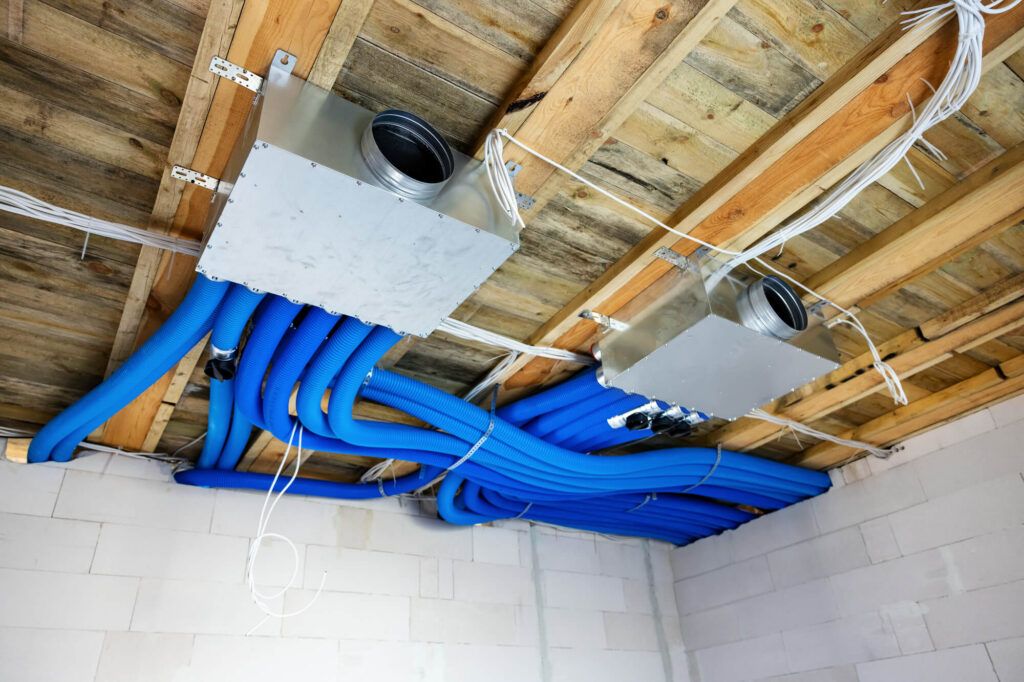
Many modern ventilation systems can integrate with HVAC trunk lines and use smart variable-speed fans for improved airflow and efficiency.
Insulated, Tight Homes and Building Science Considerations
Modern construction techniques, including high-performance building envelopes, modular construction, prefab homes, and Step Code (British Columbia) or Energy-Star-compliant designs, create homes that are significantly more airtight than older houses.
While this insulation creates more energy-efficient homes, it also makes mechanical ventilation increasingly important to secure fresh air throughout the living areas.
Generally:
- Choose an HRV if your home experiences frequent condensation, excess moisture, or damp conditions.
- Consider an ERV if your home becomes excessively dry during winter or experiences humid summers.
- Pair either system with additional humidity control when needed.
Proper installation, balancing, and airflow design are often more important than the specific technology selected.
Turning HRV vs ERV Advice Into a Plan That Fits Your Home
Choosing between an HRV and an ERV is really about understanding how your home behaves across the seasons:
- how tight (insulated) it is,
- how much moisture your routines create,
- and how sensitive your family is to stale or very dry air.
Once you see that pattern clearly, the right system to ensure fresh air daily becomes less of a guess and more of a calm, practical decision.
For most homeowners, the best HRV vs ERV ventilation system choice comes down to three questions:
- Does your home need more moisture removal or more moisture recovery?
- Does your local climate bring dry winters, humid summers, or both?
- Does your current HVAC system already manage air quality, filtration, and humidity well?
An HRV is often a strong fit for cold, tight homes that need heat recovery and moisture control. An ERV is often a strong fit for homes that face dry winters, humid summers, or a higher need for energy recovery and humidity moderation. Both systems can support better indoor air quality when they are properly designed, installed, balanced, and maintained.
Getting the Right Recommendation from Professionals like Modern PURAIR®
If you would rather not sort through all of that on your own — weighing erv and hrv systems, managing the balance between incoming fresh air and outgoing stale air, deciding how to handle excessive humidity in summer or dry winter air during the heating season, or identifying air leaks that undermine whatever erv or hrv system you install — this is a good time to turn what you have learned into a home-specific plan.
A Modern PURAIR® ventilation specialist and experienced hvac technician can review your layout, humidity trends including outdoor humidity and humidity inside the home across seasons, existing equipment, and comfort concerns — then recommend and install a balanced erv or hrv system with clear communication, upfront expectations, and visible proof of the work done to improve your indoor air quality. Whether the goal is replacing stale indoor air with fresh outdoor air more efficiently, managing moist air and humid air during summer, protecting against dry winter air during the heating season, or achieving the energy savings that well-balanced erv and hrv systems deliver, Modern PURAIR® can help you get there without the guesswork.
That way, your ventilation, your comfort, and your inside air all move in the same direction and you can breathe a little easier every day.